
WASHINGTON, D.C. | July 22, 2026
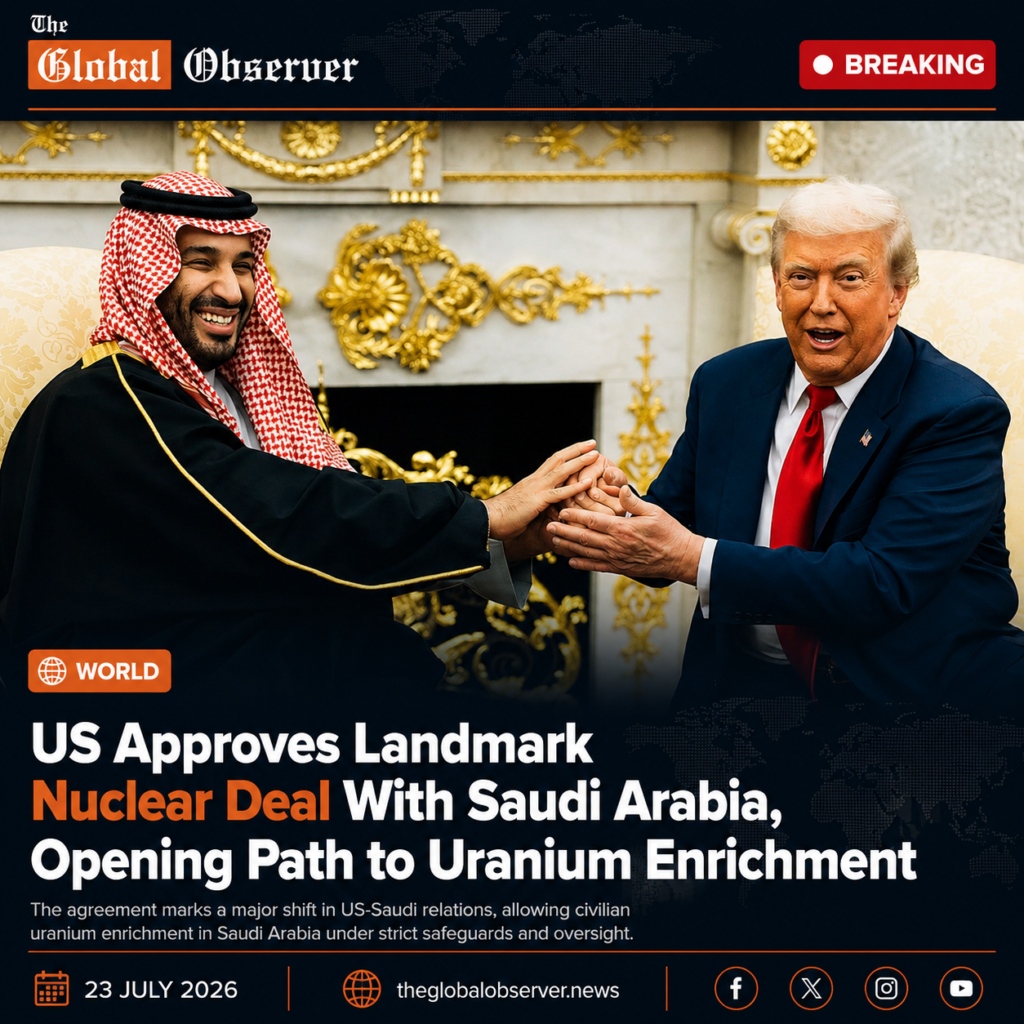
The Trump administration has approved a landmark 30-year civilian nuclear cooperation agreement with Saudi Arabia that could eventually allow the kingdom to enrich uranium on its own soil under a U.S.-supervised framework. The proposed agreement marks a significant shift in Washington’s approach to nuclear cooperation in the Middle East and is expected to trigger intense debate in Congress over regional security and nuclear proliferation.
The agreement, which still requires congressional review, is designed to support Saudi Arabia’s ambitions to develop a civilian nuclear energy industry while expanding the role of American companies in the kingdom’s energy sector. U.S. officials argue that the arrangement would help keep Riyadh aligned with Washington rather than pushing it toward nuclear partnerships with countries such as China or Russia.
Controlled Uranium Enrichment
A key feature of the agreement is a mechanism that could permit uranium enrichment inside Saudi Arabia under strict U.S. oversight.
According to officials familiar with the proposal, any enrichment facility would be operated by American companies using technology that would not be transferred to Saudi authorities. The arrangement is intended to allow Saudi Arabia to produce nuclear fuel for civilian power generation while limiting access to sensitive technologies that could be diverted for military purposes.
Supporters say this approach provides stronger safeguards than allowing Saudi Arabia to seek similar technology from other international partners with fewer restrictions.
Concerns Over Nuclear Proliferation
Despite the proposed safeguards, the agreement has raised concerns among non-proliferation experts and some U.S. lawmakers.
Critics argue that allowing uranium enrichment in Saudi Arabia—even under foreign supervision—could establish a precedent that encourages other countries in the region to pursue similar capabilities. Uranium enrichment is a dual-use technology that can produce fuel for civilian nuclear reactors but can also be adapted to produce material suitable for nuclear weapons if restrictions are removed.
Some analysts have also pointed to previous comments by Saudi Crown Prince Mohammed bin Salman, who has said the kingdom would seek nuclear weapons if Iran were ever to acquire them, adding to regional concerns.
No “Gold Standard” Restrictions
Unlike previous U.S. civilian nuclear agreements with countries such as the United Arab Emirates, the proposed Saudi pact does not reportedly require Riyadh to permanently renounce domestic uranium enrichment.
The absence of these so-called “gold standard” restrictions has become one of the most controversial elements of the proposal. Reports also indicate that the agreement does not include the International Atomic Energy Agency’s (IAEA) Additional Protocol, which provides enhanced inspection powers for international nuclear monitors.
Strategic and Economic Interests
The Trump administration argues that the agreement serves broader American strategic interests.
Officials say the deal would strengthen the long-standing U.S.-Saudi partnership, create business opportunities for American nuclear technology companies, and prevent rival powers from dominating Saudi Arabia’s emerging nuclear energy market. American firms are expected to play a leading role in designing, constructing and operating future nuclear facilities under the agreement.
The proposal also comes amid heightened tensions with Iran, whose nuclear program remains a central security concern across the Middle East.
Congressional Review Ahead
Before taking effect, the agreement must be submitted to the U.S. Congress for review, where it is expected to face close scrutiny from lawmakers in both parties.
Several members of Congress have already expressed concerns about the proliferation risks associated with allowing uranium enrichment in Saudi Arabia. Others, however, argue that a carefully regulated partnership with Washington is preferable to Riyadh pursuing nuclear cooperation with geopolitical rivals.
Regional Implications
The proposed agreement could reshape the Middle East’s strategic landscape.
Supporters believe it would reinforce U.S. influence in the region while helping Saudi Arabia diversify its energy mix beyond oil. Critics warn it could accelerate a regional competition over nuclear technology and complicate efforts to prevent the spread of sensitive nuclear capabilities.
As Congress begins reviewing the agreement, the debate is likely to extend beyond energy policy, touching on international security, diplomacy and the future of nuclear non-proliferation in one of the world’s most volatile regions.