
LONDON | July 23, 2026
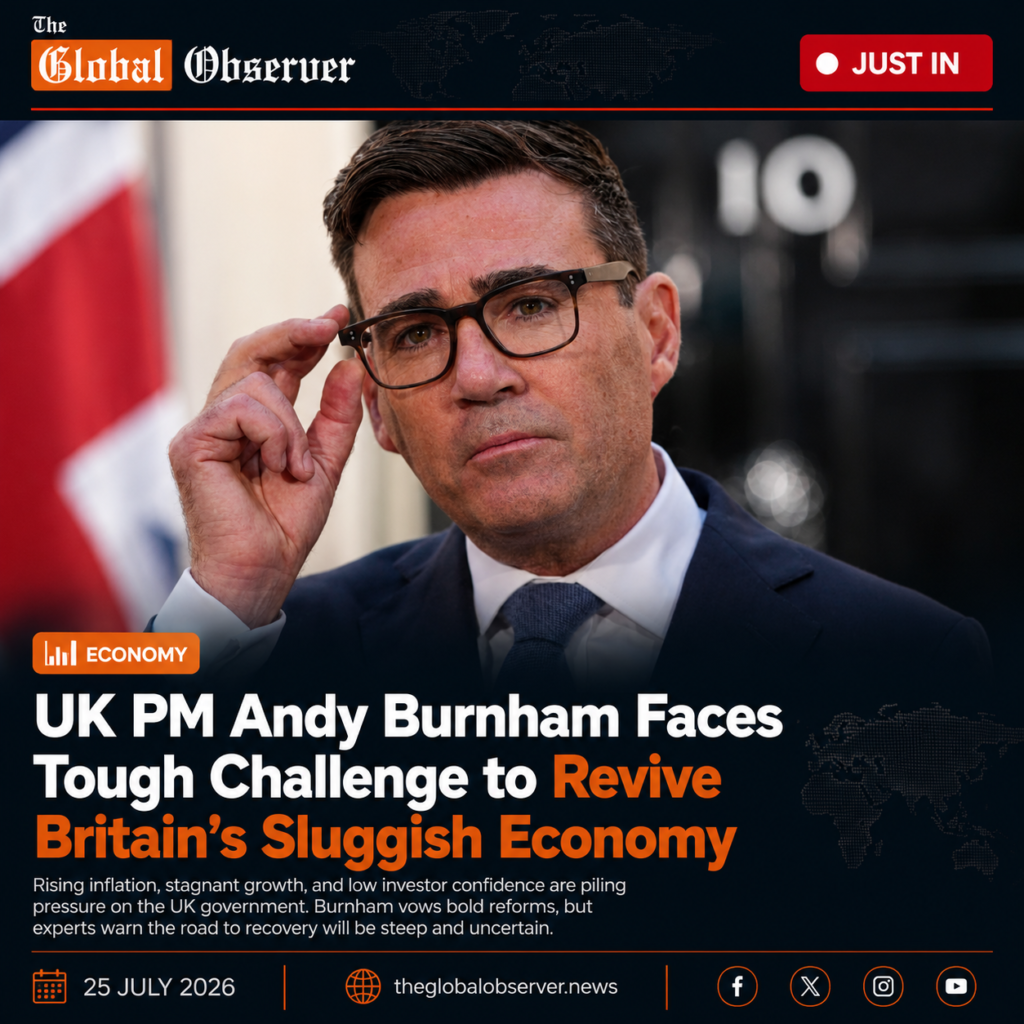
Britain’s newly appointed Prime Minister Andy Burnham has inherited one of the country’s most difficult economic landscapes in decades, with sluggish growth, high public debt, and persistent cost-of-living pressures dominating the government’s agenda.
Economic analysts say Burnham’s biggest test will be delivering meaningful growth while maintaining fiscal discipline and restoring investor confidence. His administration has pledged to reshape the British economy through long-term structural reforms rather than short-term stimulus measures.
A Slow-Growing Economy
The UK economy has struggled with weak growth since the global financial crisis, averaging annual growth of less than 1.5% over the past decade and a half. At the same time, public debt has climbed above 95% of GDP, leaving the government with limited room to increase spending without unsettling financial markets.
Although inflation has eased compared with previous highs, British households continue to face elevated living costs, while businesses remain under pressure from borrowing costs, energy prices and subdued consumer demand.
Burnham’s Economic Vision
Burnham has promised what he describes as a “new economic model” focused on rebuilding Britain’s industrial base, decentralizing economic decision-making and giving greater powers to regional governments.
His strategy includes increasing investment in transport, housing and infrastructure outside London while encouraging local authorities to play a larger role in driving economic development. The Prime Minister argues that sustainable growth cannot be achieved through centralized policymaking alone and has pledged to deliver “good growth in every postcode.”
Balancing Growth and Fiscal Discipline
Despite ambitious spending plans, Burnham has repeatedly emphasized that his government will continue to follow Britain’s fiscal rules.
His administration faces the difficult task of supporting households and businesses without significantly increasing borrowing or raising major taxes. Economists warn that maintaining this balance will require difficult political choices, particularly as defence spending and debt-servicing costs continue to rise.
The appointment of former Defence Secretary John Healey as Treasury chief has been widely interpreted as a signal that the government intends to maintain strict control over public finances.
Early Policy Measures
Among Burnham’s first economic initiatives was a temporary suspension of the electricity levy for households, designed to provide immediate cost-of-living relief.
The government has also announced a 20% reduction in business rates for pubs, clubs and live music venues in England beginning next year. Officials say the measure is intended to revitalize local high streets and support small businesses struggling with rising operating costs.
Additional reforms to the business rates system and measures targeting tax avoidance by online marketplaces are also under consideration.
Long-Term Challenges
Beyond immediate economic pressures, the Burnham government faces several structural challenges, including regional inequality, weak productivity, housing shortages and declining public confidence in public services.
Business leaders argue that sustained investment in infrastructure, workforce skills and innovation will be essential if Britain is to achieve stronger long-term growth. At the same time, financial markets are expected to closely monitor the government’s borrowing and spending decisions.
Analysts note that stronger economic performance will be crucial not only for improving living standards but also for funding public services without placing additional pressure on taxpayers.
Outlook
Economists say Burnham’s success will ultimately depend on whether his government can translate its long-term vision into measurable economic improvements.
While investors have broadly welcomed the emphasis on fiscal responsibility, many remain cautious about the government’s ability to deliver sustained growth amid global economic uncertainty.
With expectations high and fiscal flexibility limited, the coming months are likely to determine whether Burnham’s promise of a “new economic model” can provide the boost Britain’s economy has struggled to achieve for years.