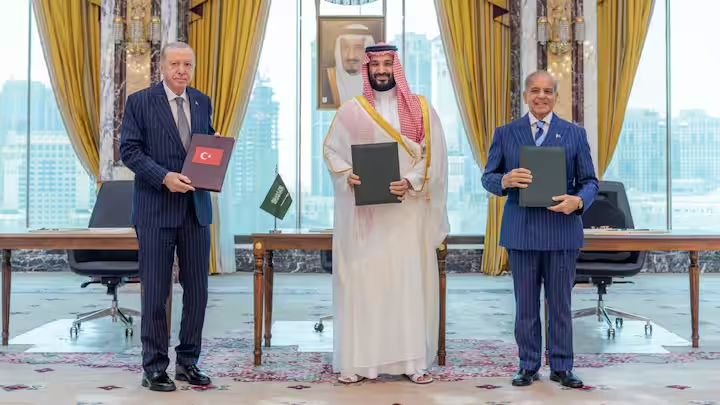

Turkey’s Foreign Minister Hakan Fidan has described the newly signed Mecca Joint Defence Agreement between Türkiye, Pakistan and Saudi Arabia as technically equivalent to NATO’s collective-defence principle under Article 5.
The agreement, signed in Mecca on August 7, establishes a mutual defence framework under which an armed attack against any one of the three countries is to be regarded as an attack against all three.
Speaking about the pact, Fidan said its core principle is comparable to NATO’s Article 5, although the agreement is a separate regional arrangement and does not replace the countries’ existing alliances or defence commitments.
The agreement comes at a time of heightened tensions across West Asia. Türkiye, Pakistan and Saudi Arabia have presented the pact as a defensive mechanism aimed at strengthening deterrence and regional security, rather than an alliance directed against a particular country. Turkish and Pakistani officials have specifically rejected suggestions that the agreement was designed to target Iran.
Under the arrangement, the three countries will establish mechanisms for closer defence coordination. A ministerial committee and a permanent secretariat in Saudi Arabia are expected to oversee the implementation of the agreement, while further details will be discussed during the alliance’s initial meetings.
The pact also reflects the growing strategic relationship between Ankara, Islamabad and Riyadh. Pakistan brings significant military experience and nuclear deterrence capabilities, while Türkiye contributes a major NATO-member military with advanced defence technology. Saudi Arabia, meanwhile, brings substantial economic resources and considerable regional influence.
Fidan has also indicated that the framework could eventually expand. Egypt has been mentioned as a potential future participant, although no decision on membership has been announced.
The agreement is already attracting considerable attention because of its potential impact on the security balance in both West and South Asia. Analysts are debating whether it could develop into a broader regional security structure or remain primarily a political and deterrence-focused partnership.
For now, the three signatories insist that the agreement is defensive in nature and intended to strengthen collective security while responding to the changing strategic environment in the region. Pakistan’s Foreign Minister Ishaq Dar has also described the pact as purely defensive and said it remains open to other countries that are willing to cooperate under its principles.
The Mecca agreement could therefore mark a significant new chapter in regional defence cooperation, bringing together three influential Muslim-majority states under a collective-security framework.