
NEW DELHI | July 22, 2026
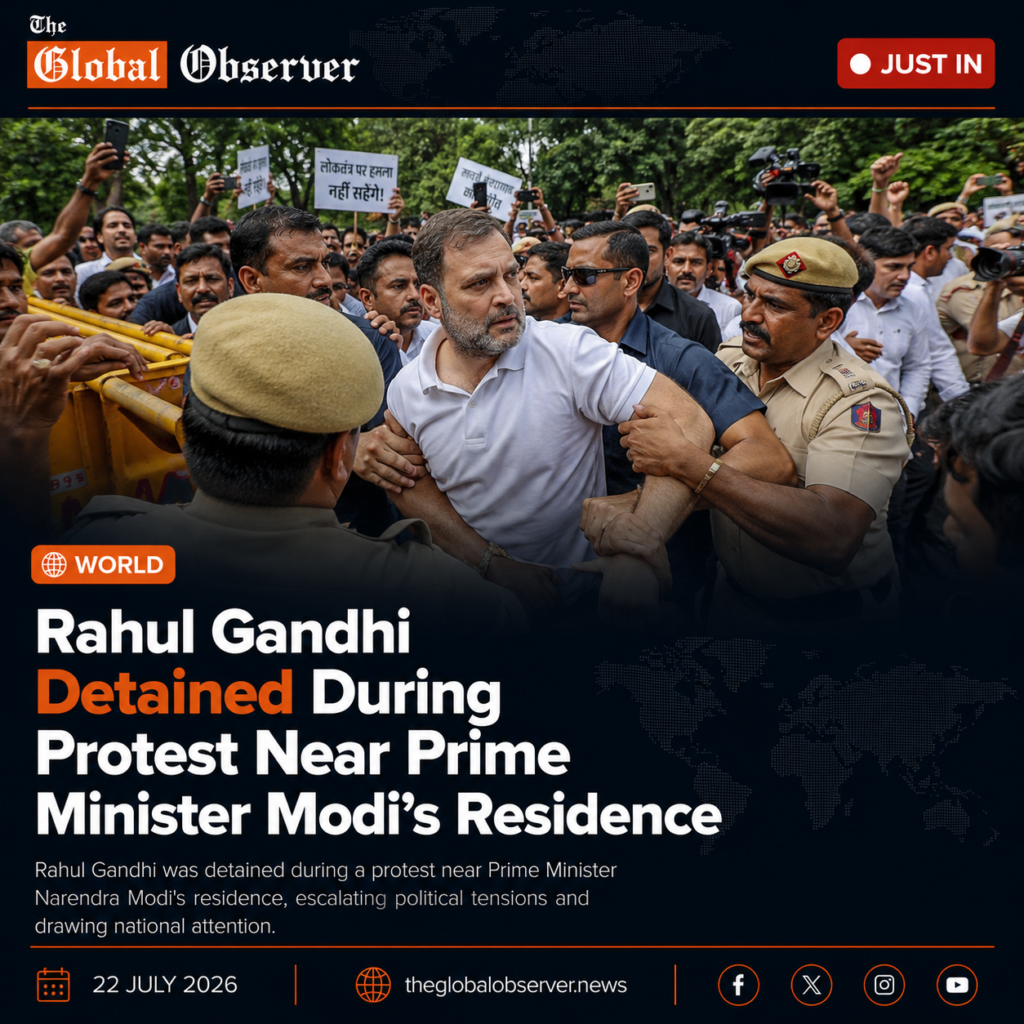
Indian opposition leader Rahul Gandhi was briefly detained by police on Tuesday after participating in a protest march toward Prime Minister Narendra Modi’s official residence in New Delhi. The demonstration, organized by the opposition Indian National Congress (INC) and its allies, focused on allegations of irregularities in the country’s electoral process and called for greater accountability from the government.
The protest drew hundreds of party workers, lawmakers and supporters who gathered in central New Delhi before marching toward the Prime Minister’s residence. Authorities had imposed security restrictions around the high-security zone, preventing demonstrators from entering the area. Police erected barricades and deployed a large number of personnel to contain the crowd.
Protest Ends in Police Detentions
As protesters attempted to move beyond the security barricades, police intervened and detained several senior Congress leaders, including Rahul Gandhi. Eyewitnesses reported that officers escorted Gandhi and other opposition lawmakers into police vehicles before transporting them to a nearby police facility.
Authorities later confirmed that the detentions were preventive in nature and that those taken into custody were released after routine legal procedures. No major injuries or large-scale violence were reported during the operation.
Congress Raises Election Concerns
The Congress party said the demonstration was intended to highlight what it described as serious concerns over the integrity of India’s electoral system.
According to party leaders, the protest centered on demands for greater transparency regarding the management of voter rolls and electoral procedures. Congress has also called for broader institutional reforms to strengthen public confidence in democratic processes.
Speaking during the protest, Rahul Gandhi accused the government of undermining democratic institutions and urged authorities to respond to the opposition’s concerns through open dialogue rather than police action.
Government Defends Police Action
Indian authorities defended the police response, stating that the restrictions around the Prime Minister’s residence are part of standard security protocols. Officials said demonstrations are not permitted within the protected zone because of national security considerations.
Police maintained that the gathering became unlawful once protesters attempted to cross security barriers and that temporary detentions were necessary to maintain public order and ensure security around government buildings.
Growing Political Tensions
The incident comes amid increasing political tensions between the ruling Bharatiya Janata Party (BJP) and the opposition alliance ahead of several important political events.
Congress has intensified its campaign against the government in recent months, raising issues related to governance, economic conditions and electoral transparency. The ruling BJP has rejected the opposition’s allegations, insisting that India’s democratic institutions remain independent and robust.
Political analysts say Tuesday’s confrontation reflects the increasingly confrontational relationship between India’s government and opposition, with street protests becoming a more frequent feature of the country’s political landscape.
Public and Political Reactions
Images of Rahul Gandhi being escorted by police quickly spread across social media, generating widespread discussion among political supporters and critics alike.
Opposition parties condemned the detentions, arguing that peaceful protest is a fundamental democratic right. Government supporters, however, argued that security rules around the Prime Minister’s residence must be respected regardless of political affiliation.
The incident is expected to fuel further debate over the balance between public security and the right to peaceful assembly in the world’s largest democracy.
What Happens Next?
Congress leaders have indicated that they will continue raising concerns through parliamentary debates, legal avenues and public demonstrations. The party has also called for an independent review of the issues it raised during the protest.
While Rahul Gandhi has been released, the political impact of the incident is likely to continue in the coming days as both the government and opposition seek to shape public opinion ahead of future political contests.
Observers say the episode highlights the increasingly polarized nature of Indian politics, where disagreements over governance and democratic institutions continue to dominate national debate.