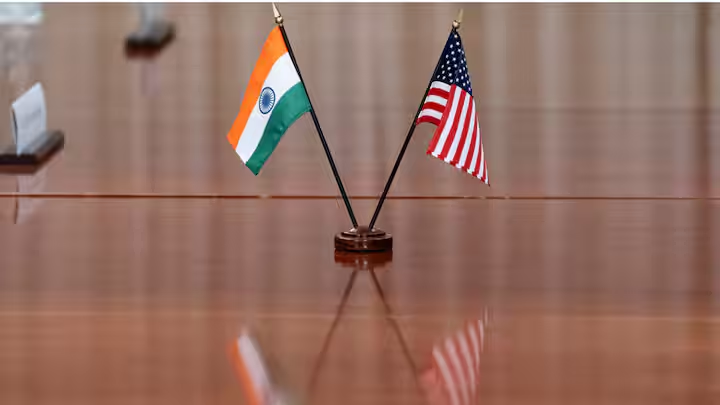

New Delhi: India and the United States remain committed to finalising a bilateral trade agreement despite growing uncertainty over a proposed US tariff of up to 100% on countries continuing to buy Russian energy, India’s Commerce Secretary Rajesh Agarwal has said.
Agarwal said the two countries remain in regular contact over the proposed trade pact and are continuing discussions despite the fresh pressure created by Washington’s Russia-related tariff measures.
The latest development comes as the United States considers additional economic measures targeting countries that maintain significant trade with Russia. India, one of the major buyers of Russian crude oil, could potentially face higher US tariffs if Washington proceeds with the proposed sanctions framework.
Despite the threat, New Delhi has indicated that negotiations over the India-US bilateral trade agreement have not been abandoned. Officials from both countries continue to engage on issues surrounding market access, tariffs and broader economic cooperation.
The proposed US legislation has raised concerns because it could authorise President Donald Trump to impose tariffs of up to 100% on imports from countries that continue significant purchases of Russian oil and gas. India and China are among the countries that could be affected by such measures.
However, the tariff threat has not yet translated into an automatic 100% duty on Indian goods. The legislation would provide the US president with the authority to impose such tariffs, meaning the final decision and implementation would depend on subsequent action from Washington.
For India, the issue is particularly sensitive because Russian crude has remained an important component of the country’s energy imports. New Delhi has consistently defended its right to maintain energy and trade relationships based on national interests, while Washington has been seeking to increase economic pressure on Moscow over the war in Ukraine.
Against this backdrop, the continuation of India-US trade negotiations could become increasingly important for both sides.
The United States is one of India’s most important trading partners, while Indian exporters have significant exposure to the American market. India’s commerce ministry has previously described the US as the country’s largest trading partner, with bilateral merchandise trade exceeding $118 billion in 2023-24.
Agarwal’s latest comments therefore suggest that both governments are attempting to keep the trade dialogue separate from the wider disagreement over India’s purchases of Russian energy.
The negotiations could nevertheless face difficult choices ahead. Washington wants stronger assurances on trade and Russia-related policies, while New Delhi is expected to prioritise its energy security and protect the interests of Indian farmers, manufacturers, exporters and businesses.
For now, India’s message remains clear: the threat of tougher US tariffs has increased the pressure, but it has not ended the effort to reach a trade agreement.
The coming weeks could prove crucial as both sides attempt to balance commercial interests with increasingly complicated geopolitical considerations.