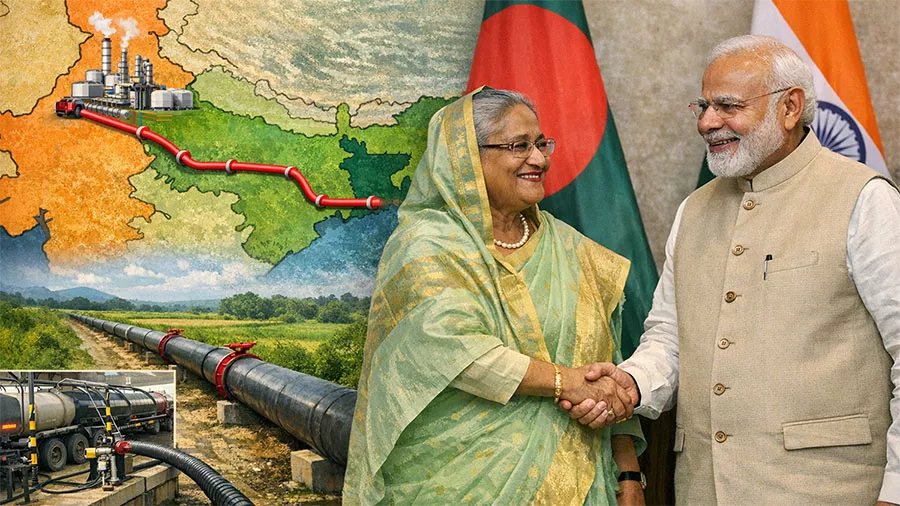

Dhaka/Dinajpur: Bangladesh has received around 8.23 million litres of diesel from India through the India-Bangladesh Friendship Pipeline, with the latest shipment reaching the Parbatipur depot in Dinajpur.
The latest consignment, equivalent to approximately 7,000 tonnes of diesel, began arriving on the evening of August 10 and the unloading process was completed at around 9:30am on August 14. It was the 68th shipment transported through the cross-border pipeline.
According to the reported figures, the shipment contained exactly 8,235,290 litres of diesel, calculated at 1,176.47 litres per tonne. The imported fuel will be distributed among Bangladesh Petroleum Corporation’s three major marketing companies—Padma Oil, Meghna Petroleum and Jamuna Oil—for supply to different parts of the country.
A direct fuel link between India and Bangladesh
The India-Bangladesh Friendship Pipeline was inaugurated in March 2023 as a major energy cooperation project between the two neighbouring countries.
The pipeline stretches for approximately 131.57 kilometres in total, including around 5 kilometres on the Indian side and 126.57 kilometres inside Bangladesh. It connects India’s Numaligarh Refinery with the receiving terminal at Parbatipur in Dinajpur.
Within Bangladesh, the pipeline passes through several areas of Panchagarh, Nilphamari and Dinajpur before reaching the Parbatipur terminal. Installed several feet underground, the system allows diesel to be transported directly rather than relying entirely on conventional road or rail networks.
More than 3 million tonnes imported since 2023
The latest shipment also adds to a much larger flow of fuel through the pipeline.
Since the facility began operations in March 2023, Bangladesh has imported more than 3.14 million tonnes of diesel from India, according to the report. The pipeline has an annual transportation capacity of approximately 1 million metric tonnes.
The project was developed under a long-term agreement between Bangladesh and India. The agreement envisaged gradually increasing diesel imports over several stages, with the aim of strengthening Bangladesh’s fuel security and meeting growing domestic demand.
Reducing dependence on road and rail
One of the major advantages of the pipeline is its potential to reduce Bangladesh’s dependence on road and railway transportation for moving imported petroleum products.
Previously, significant quantities of fuel destined for northern Bangladesh had to be transported by rail. The pipeline provides a more direct route to the Parbatipur depot, potentially reducing transportation costs and allowing fuel to reach the northern region more efficiently.
The project is particularly important for Bangladesh because a substantial portion of the country’s refined fuel requirements is met through imports. A dedicated cross-border pipeline therefore provides an additional channel for maintaining a stable supply.
The latest delivery comes as Bangladesh continues to manage its broader energy requirements. With another 7,000 tonnes of diesel now safely delivered to Parbatipur, the Friendship Pipeline once again demonstrates its role as an important component of the country’s fuel distribution network.
As energy demand continues to grow, the pipeline is expected to remain a key route for transporting petroleum products from India to Bangladesh, particularly for meeting the fuel needs of the country’s northern districts.