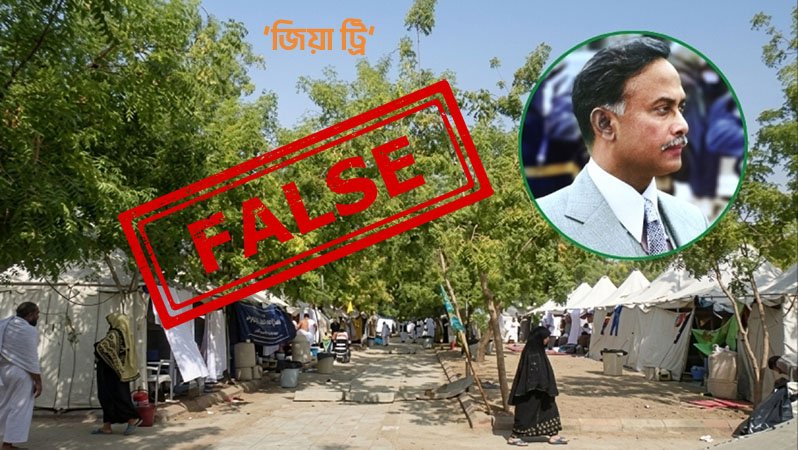

Dhaka: A recent claim attributed to Bangladesh Prime Minister Tarique Rahman regarding a tree associated with his father, former President Ziaur Rahman, at the historic plain of Arafat in Saudi Arabia has come under scrutiny, with questions being raised over whether the story is supported by available Saudi historical records.
The issue has attracted attention because Arafat is one of the most significant sites in the Islamic world and has been associated with the annual Hajj pilgrimage for centuries. Any claim about a particular tree being planted or preserved there therefore carries historical significance.
According to the report published by BDDigest, Tarique Rahman has spoken about a tree connected to Ziaur Rahman at Arafat. The report argues that the story does not appear to have clear support in publicly available Saudi historical documentation.
Questions over the historical record
The report’s central argument is that claims surrounding the tree should be examined against documented Saudi records rather than relying solely on political narratives or oral accounts.
Saudi Arabia has maintained extensive records relating to the development and management of the holy sites, particularly Arafat, Mina and Muzdalifah. Over the decades, these areas have undergone substantial infrastructure development to accommodate millions of pilgrims.
However, the BDDigest report says it has not found sufficient historical evidence in available records to independently establish the specific story surrounding Ziaur Rahman’s alleged connection to the tree.
Political history meets religious heritage
The controversy has emerged at a time when historical narratives surrounding Bangladesh’s political leaders are increasingly becoming part of public debate.
Ziaur Rahman, who founded the Bangladesh Nationalist Party (BNP), remains a highly influential figure in Bangladesh’s political history. His legacy continues to play an important role in BNP’s political identity, while competing interpretations of his role in the country’s post-independence history remain politically sensitive.
Tarique Rahman’s statements about his father’s political and personal history consequently receive considerable attention, particularly when they involve events or locations outside Bangladesh.
What the records can—and cannot—establish
The absence of a reference in publicly accessible historical material does not automatically prove that an event never occurred. Historical records can be incomplete, particularly when dealing with informal visits, individual acts or events that were not considered significant at the time.
Therefore, the question surrounding the Arafat tree would require stronger documentary evidence—such as contemporaneous Saudi government records, photographs, official correspondence or credible eyewitness documentation—to conclusively establish the history behind the claim.
The BDDigest report presents the issue as another example of how political narratives can become intertwined with historical claims.
For now, the story remains contested rather than conclusively settled. Whether the tree associated with Ziaur Rahman actually existed at Arafat, when it was allegedly planted and what official Saudi records say about it are questions that require further documentary verification.
Note: The claims and historical conclusions above reflect the referenced BDDigest report; they should not be treated as independently verified historical facts without additional primary-source evidence.