
Washington: US President Donald Trump has announced that he intends to declare the strategically vital Strait of Hormuz a US territory, escalating tensions with Iran and adding a new dimension to the ongoing conflict in the region.
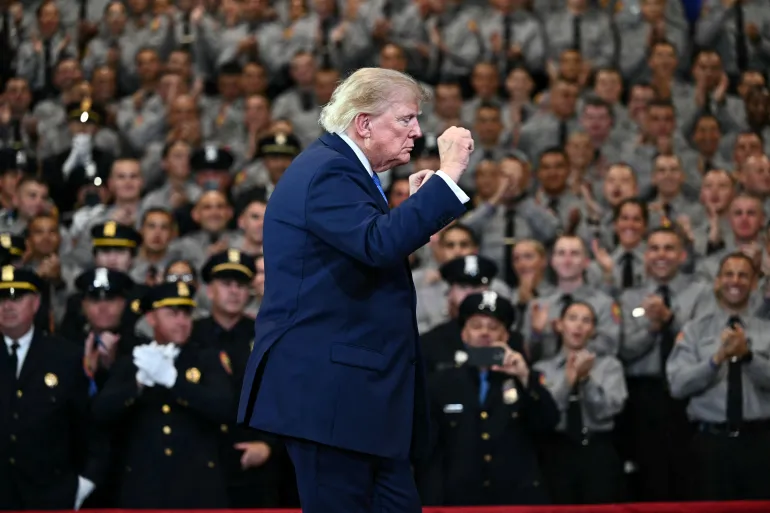
Speaking in New York on Friday, August 14, Trump said the declaration would come after what he described as the defeat of Iran. He claimed the United States already exercises effective control over the strategic waterway through its ongoing blockade.
“After we finish defeating Iran … pretty soon I’ll be declaring the Hormuz Strait a territory of the United States,” Trump said during his remarks.
Trump did not explain how such a declaration would be implemented or what legal authority Washington would use to claim sovereignty over the international waterway.
Why the Strait of Hormuz matters
The Strait of Hormuz is one of the world’s most strategically important maritime passages. Located between Iran and Oman, it provides a crucial route for energy shipments from the Persian Gulf to international markets.
Any prolonged disruption to shipping through the strait could have major consequences for global energy supplies, potentially affecting oil and gas prices far beyond the Middle East.
The waterway has already become a major flashpoint during the US-Iran conflict, with commercial shipping severely disrupted and the United States maintaining a naval blockade around Iranian ports.
Trump has repeatedly argued that Washington has established control over the passage. Earlier on Friday, he told Fox News that the United States “totally” controls the strait and claimed that ships are being allowed through only when Washington permits them.
Iran rejects Trump’s claim
Tehran has immediately pushed back against Trump’s remarks.
Iranian Deputy Foreign Minister Kazem Gharibabadi said the United States could not intimidate Iran through threats or military pressure. Iranian officials have maintained that the Strait of Hormuz remains under Iranian authority and that decisions concerning its opening or closure rest with Tehran.
The Iranian response underscores the potential for Trump’s proposal to further intensify an already dangerous confrontation between Washington and Tehran.
A new escalation in the standoff
The comments come at a time when diplomatic efforts between the United States and Iran remain stalled. Washington has continued applying military and economic pressure on Tehran, while Iran has resisted demands surrounding the reopening of the strait and broader negotiations.
The United States has also indicated that its naval blockade could continue indefinitely, increasing pressure on Iran while simultaneously creating uncertainty for international shipping and energy markets.
For now, Trump’s statement remains an announcement rather than an implemented change in the legal status of the waterway. He provided no details about a timeline, legal mechanism or international response.
However, any attempt by the United States to formally claim the Strait of Hormuz would have enormous geopolitical implications.
With Iran insisting that the strait remains under its control and Washington asserting increasing authority over maritime traffic, the future of one of the world’s most important energy routes has become another major battleground in the US-Iran confrontation.