
DHAKA | July 22, 2026
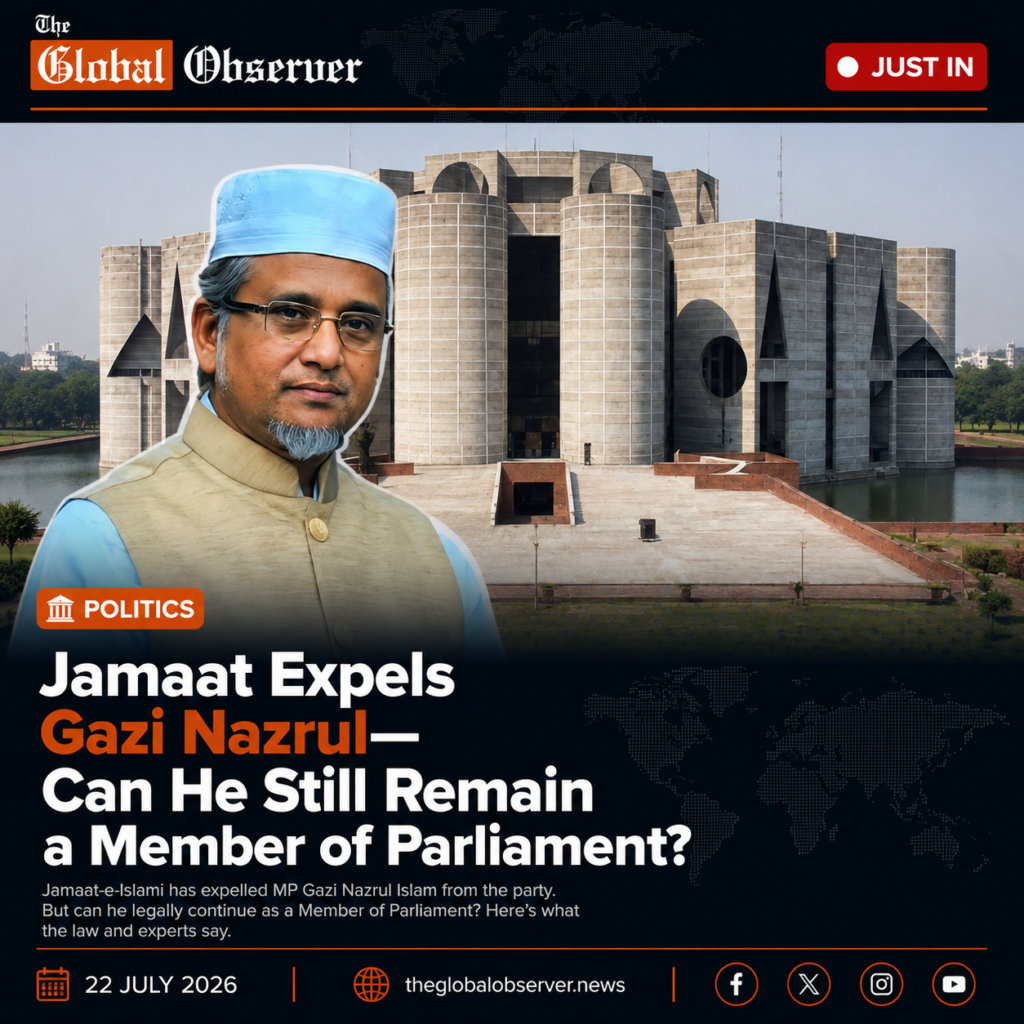
The expulsion of Satkhira-4 Member of Parliament Gazi Nazrul Islam from Bangladesh Jamaat-e-Islami has triggered fresh debate over the future of his parliamentary seat and whether he can continue serving as an MP despite no longer being a member of the political party that nominated him.
Jamaat-e-Islami announced Gazi Nazrul Islam’s expulsion following an internal investigation into allegations of what the party described as “moral misconduct.” The decision came after videos involving the lawmaker circulated widely on social media, generating significant public attention. The party has also said it will formally notify the Election Commission (EC) of its decision.
Does Expulsion Automatically Cost Him His Seat?
Constitutional experts say the answer is no.
According to parliamentary affairs specialists, expulsion from a political party does not automatically result in the loss of a parliamentary seat. Under Bangladesh’s Constitution, an MP elected on a party ticket does not lose membership simply because the party later removes them from its organization.
Former Chittagong University professor and parliamentary affairs researcher Nizam Ahmed explained that Gazi Nazrul Islam could continue serving in parliament unless specific constitutional conditions requiring the seat to become vacant are met. In such a situation, he would effectively function as an independent member rather than as a representative of Jamaat-e-Islami.
What Does the Constitution Say?
Legal experts point to Article 70 of the Constitution of Bangladesh, which governs party discipline in parliament.
The provision states that an MP elected on a political party’s nomination must vacate the seat if the member voluntarily resigns from that party or votes against the party in parliament under circumstances specified by the Constitution.
However, constitutional specialists argue that the article does not explicitly state that expulsion by the party itself automatically vacates the parliamentary seat. As a result, experts believe Gazi Nazrul Islam’s status as an MP is unlikely to change solely because Jamaat has expelled him.
Could He Lose His Seat Later?
Legal analysts say there are other constitutional provisions that could affect parliamentary eligibility, but those would require separate legal proceedings.
Experts have referred to Article 66, which outlines qualifications and disqualifications for Members of Parliament. If a lawmaker is convicted of a criminal offence involving moral turpitude and receives a qualifying prison sentence under the Constitution, that conviction could eventually affect eligibility to remain in parliament. At present, however, no such judicial determination has been made in this case.
Role of Parliament and the Election Commission
Parliamentary officials have indicated that no immediate action can be taken unless the relevant authorities receive formal documentation.
According to parliamentary sources quoted by The Daily Star, Parliament had not yet received any official communication regarding Jamaat’s decision at the time of reporting. Once such a notification is received, the matter would be examined in accordance with constitutional and legal procedures.
Meanwhile, Jamaat has confirmed that it intends to inform the Election Commission about the expulsion. The EC may review the matter within the framework of existing election laws, although constitutional experts note that any decision concerning parliamentary membership must comply with constitutional provisions.
Political Significance
The case has attracted nationwide attention because it involves a sitting Member of Parliament from one of Bangladesh’s major political parties.
Political observers say the incident may become an important constitutional reference point, particularly regarding the relationship between party discipline and parliamentary membership. The outcome could also shape future discussions about the rights and responsibilities of elected representatives after disciplinary action by their political parties.
What Happens Next?
For now, legal experts broadly agree that Gazi Nazrul Islam remains a Member of Parliament unless a constitutional or judicial process determines otherwise. His expulsion from Jamaat-e-Islami alone does not automatically create a vacancy in the Satkhira-4 parliamentary seat.
Any future change in his parliamentary status would depend on constitutional provisions, decisions by the relevant authorities, or the outcome of any legal proceedings that may arise.