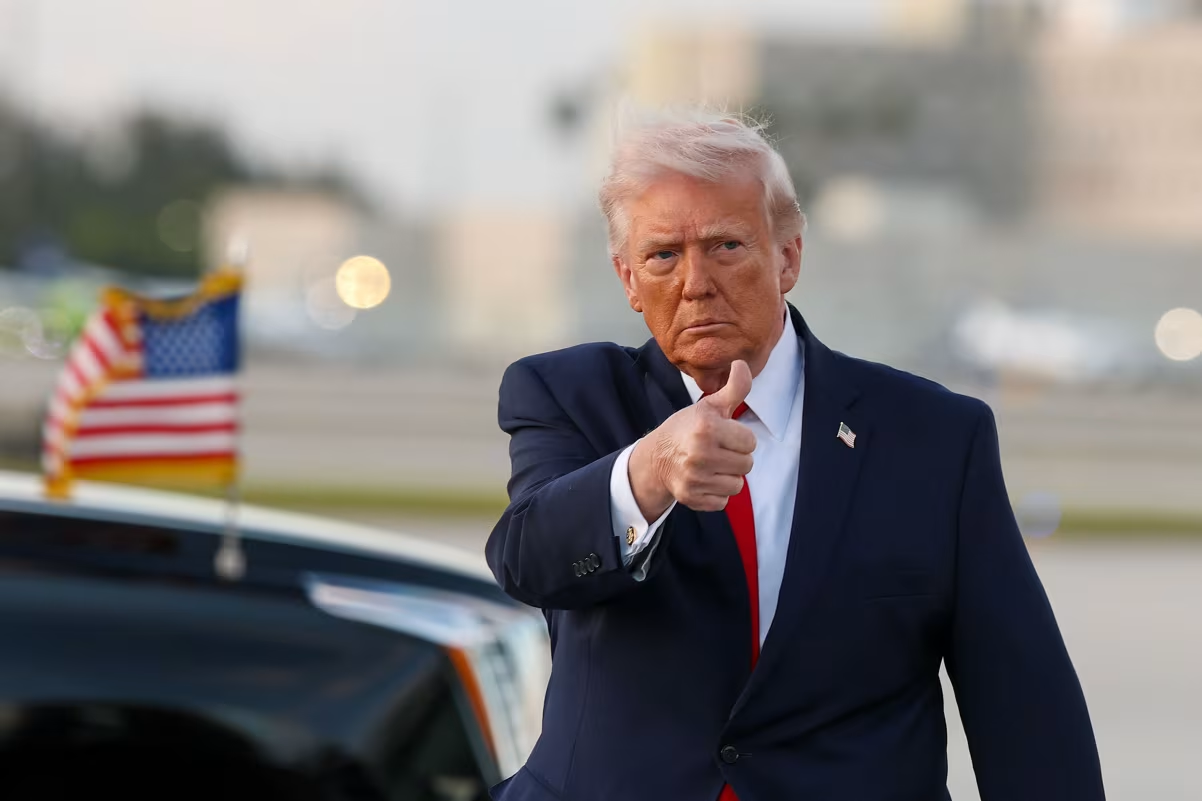

The administration of U.S. President Donald Trump is doubling down on an optimistic economic narrative, insisting that the economy remains strong even as rising fuel costs, inflation concerns, and public sentiment point in a more complicated direction.
After initially framing the economic impact of the Iran conflict as “short-term pain for long-term gain,” Trump and his senior officials have increasingly shifted back to a more reassuring message: that the economy is performing well and Americans should remain confident.
Speaking in a recent interview, Trump highlighted the resilience of financial markets, particularly pointing to gains in the S&P 500. He argued that while oil prices have risen to around $92 per barrel, the situation could have been far worse, referencing earlier projections that prices might surge significantly higher.
“To be honest, we are doing so well,” Trump said, adding that he was “very happy” with current economic conditions.
The president has continued to emphasize similar themes in public appearances, describing inflation as “very low” despite recent data showing it has climbed to its highest level in two years. He has also downplayed concerns over rising fuel costs, arguing that current gas prices remain below worst-case scenarios.
Trump further characterized inflation as “fake,” attributing it largely to increases in energy prices rather than broader economic weaknesses. He reiterated his long-standing claim that the U.S. economy is outperforming expectations, comparing it favorably to his first term in office.
Other administration officials have echoed this message. White House press secretary Karoline Leavitt pointed to a modest decline in gas prices over the past year, urging Americans to consider broader trends rather than short-term fluctuations.
Meanwhile, Treasury Secretary Scott Bessent argued that the underlying strength of the economy enabled the administration to navigate geopolitical tensions. He also suggested that consumer behavior tells a more positive story than public opinion surveys.
“The consumer, while they may be sounding grim, is actually quite buoyant,” Bessent said, pointing to continued spending levels. He went further, suggesting that Americans may feel more confident about the economy than they express in surveys, stating that “in their heart of hearts, they feel good.”
There is some data that supports parts of this argument. Consumer spending has remained relatively strong in the post-pandemic period, and stock markets have rebounded after early volatility linked to the Iran conflict. These indicators suggest that key economic fundamentals have not deteriorated as sharply as public perception might indicate.
However, sentiment data paints a starkly different picture. The widely followed University of Michigan consumer sentiment index recently fell to one of its lowest levels on record, reflecting deep pessimism among Americans about current and future economic conditions. The index is now lower than during major economic downturns, including the late-2000s financial crisis.
Polling data reinforces this trend. Surveys show that only a small share of Americans currently view the economy as performing well, while a clear majority expect conditions to remain weak in the coming year. Rising fuel prices, in particular, have emerged as a significant concern, with many households reporting that they have adjusted their spending habits in response.
In addition, a growing number of Americans believe that Trump’s policies have negatively impacted the economy. Recent polling indicates that far more respondents say economic conditions have worsened under his leadership than improved—a gap that has widened in recent months.
This divergence between official messaging and public perception presents a significant political challenge. A similar strategy was employed by the administration of Joe Biden following the post-pandemic inflation surge, when officials highlighted improving economic indicators. However, that messaging struggled to resonate with voters and contributed to declining approval ratings on economic issues.
Analysts warn that relying too heavily on positive framing—while dismissing or minimizing voter concerns—can be a risky approach. While macroeconomic indicators such as stock market performance and consumer spending remain relatively stable, everyday experiences such as higher gas prices and cost-of-living pressures often shape public opinion more directly.
The ongoing geopolitical tensions, particularly those involving Iran, have further complicated the economic outlook. Energy price volatility and supply chain disruptions continue to create uncertainty, making it more difficult for the administration to sustain its optimistic narrative.
Ultimately, the challenge for Trump and his team lies in bridging the gap between economic data and lived experience. While officials argue that the fundamentals remain strong, many Americans appear unconvinced—raising questions about whether the “all is well” message can hold in the face of persistent economic anxiety.