
The U.S. Congress has approved a short-term extension of a కీల foreign surveillance program after Republican lawmakers broke with Donald Trump and blocked efforts to secure a longer-term renewal, exposing deep divisions within the party over national security and civil liberties.
The measure extends Section 702 of the Foreign Intelligence Surveillance Act (FISA) only until April 30, buying lawmakers additional time to negotiate reforms. The program, which was set to expire Monday night, allows U.S. intelligence agencies to monitor communications of foreign targets abroad, though it can also incidentally collect data involving American citizens.
The legislation now heads to the White House, where Trump is expected to sign it into law despite having pushed aggressively for a longer extension.
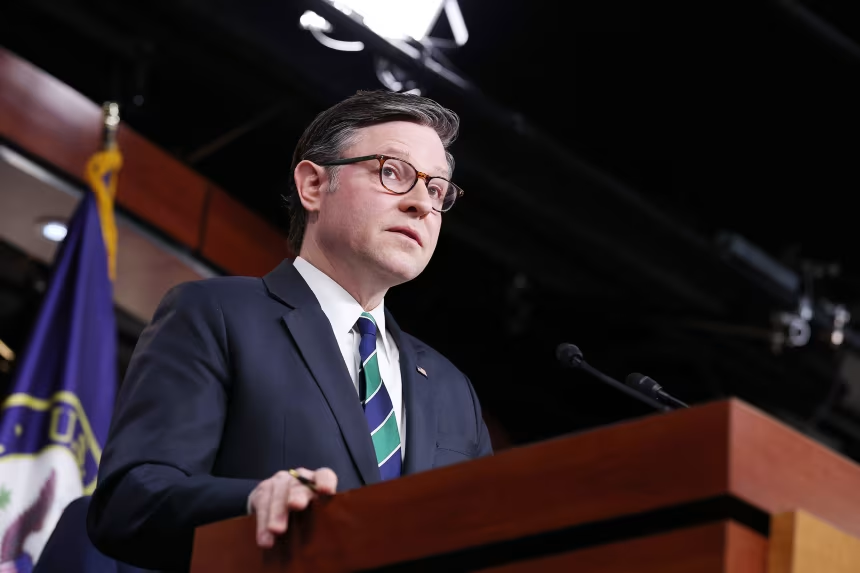
The decision follows a dramatic series of late-night votes in the House of Representatives, where Speaker Mike Johnson suffered a significant setback. Republican leaders had spent days negotiating with conservative holdouts in an attempt to pass an 18-month or longer reauthorization. However, more than a dozen GOP lawmakers ultimately rejected the proposal, citing unresolved concerns about privacy protections.
The failed effort marked a rare public split within Republican ranks, as lawmakers defied direct appeals from Trump and party leadership. In total, around 20 Republicans voted against advancing the longer-term extension, forcing leadership to pivot to a temporary solution.
The short-term extension passed amid mounting pressure from national security officials, who have repeatedly warned that allowing FISA authorities to lapse could create dangerous intelligence gaps. The program is widely viewed by intelligence agencies as a critical tool for tracking terrorism threats, combating cyberattacks, and monitoring foreign adversaries.
In the Senate, the measure briefly faced uncertainty when Ron Wyden, a longtime critic of Section 702, considered blocking its passage. Wyden ultimately allowed the extension to proceed, stating that assurances from House lawmakers increased the likelihood of meaningful reforms during the extension period.
“Expiration makes reform less likely,” Wyden said, signaling reluctant support for the temporary measure.
Despite broad bipartisan acknowledgment of the program’s national security value, the debate has increasingly centered on concerns that Section 702 infringes on Americans’ constitutional rights. Critics argue that the law permits warrantless searches of communications that may include U.S. citizens, raising serious privacy issues.
Republican lawmakers such as Chip Roy have been particularly vocal in demanding stronger safeguards, including a requirement that authorities obtain a warrant before accessing Americans’ data collected under the program.
“Right now, we all agree this tool is needed,” Roy said earlier in the week. “But we need to figure out how we’re protecting American citizens in the process.”
Efforts to incorporate such reforms into the long-term extension proved unsuccessful, contributing to the collapse of the proposed deal. Frustration among rank-and-file Republicans was evident during the late-night session, with some lawmakers openly criticizing the negotiated package.
Following the defeat, Speaker Johnson acknowledged the challenges ahead but expressed optimism that a compromise could still be reached.
“We were very close,” Johnson told reporters. “There are nuances with language and questions that need to be resolved. The extension gives us time to get that done.”
Johnson emphasized that FISA remains a “critical national security tool,” adding that lawmakers must balance the need for robust intelligence capabilities with the protection of civil liberties.
Meanwhile, Senate Republicans signaled they may take a more active role in shaping the final outcome. Senate Majority Leader John Thune suggested that the upper chamber could pursue its own version of the legislation, potentially including a three-year extension.
“We can’t go dark,” Thune warned, referring to the risk of intelligence blind spots if the program expires.
Democrats have also urged swift action, highlighting the potential consequences of a lapse in surveillance authority. Angus King, an independent who caucuses with Democrats and sits on the Senate Intelligence Committee, described FISA as “the single most important national security asset” available to the U.S. government.
The urgency is heightened by ongoing geopolitical tensions, including a fragile ceasefire involving Iran. According to current and former officials, intelligence agencies have been preparing contingency plans in case the surveillance authority lapses, which could hinder the U.S.’s ability to monitor evolving threats.
For now, the short-term extension averts an immediate shutdown of the program. However, the political standoff underscores the difficulty of reconciling national security priorities with growing demands for stronger privacy protections—an issue that lawmakers will need to resolve before the new deadline at the end of April.