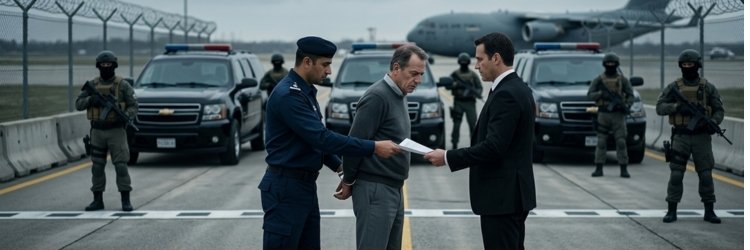

French authorities have taken into custody a 72-year-old man suspected of involvement in the deadly 1982 attack on a Jewish restaurant in Paris, marking a significant development in a case that has remained unresolved for more than four decades.
The suspect, identified as Hicham Harb—whose real name is Mahmoud Khader Abed Adra—was extradited on Thursday by the Palestinian National Authority following a formal request from France’s National Anti-Terrorism Prosecutor’s Office (PNAT) issued last September.
Harb is accused of directing the participating as one of the gunmen in the assault on a Jewish restaurant on Rue des Rosiers, located in the historic Marais district of Paris. The attack, which involved a grenade explosion followed by gunfire, left six people dead and more than 20 others injured.
Upon arrival at the Villacoublay Air Force Base, Harb was immediately placed in detention, according to French prosecutors. His extradition is seen as a breakthrough in a long-stalled investigation, as no individual has ever been convicted for the killings.
French President Emmanuel Macron welcomed the development, thanking Palestinian authorities for their cooperation. He described the extradition as “a concrete demonstration” of judicial collaboration, particularly in the context of France’s recognition of a Palestinian state in September 2025.
The 1982 attack targeted the well-known Jo Goldenberg restaurant, a landmark in the Jewish quarter. Assailants reportedly threw a grenade into the crowded dining area before entering and opening fire with automatic weapons as patrons attempted to flee.
The attack was attributed to a faction linked to Abu Nidal, whose breakaway organization was responsible for numerous high-profile attacks during the 1980s. The group split from the Palestine Liberation Organization and was blamed for hundreds of deaths globally through acts including hijackings, assassinations, and shootings.
Last year, France’s highest court, the Court of Cassation, ordered a trial for six suspects connected to the attack. Of those, three are believed to be living abroad—in the West Bank, Jordan, and Kuwait—and are expected to be tried in absentia if they cannot be extradited.
Two other suspects are already in France. One of them, Abou Zayed, a Norwegian citizen, is alleged to have been among the gunmen, though his legal team has denied any involvement. Another suspect, Hazza Taha, is accused of assisting by concealing weapons.
Harb’s extradition has been contested by his family. His son has claimed the transfer was unlawful and raised concerns about whether his father will receive a fair trial in France. However, French courts have rejected attempts to move the case to a jury trial, confirming it will instead be handled by a special panel of judges typically assigned to terrorism-related cases.
French Foreign Minister Jean-Noël Barrot reaffirmed the government’s commitment to justice, noting that he had personally assured victims’ families that every effort would be made to bring those responsible to trial.
“Faced with anti-Semitism and terrorism, France never forgets and never gives up,” Barrot said.
More than 40 years after the attack, the extradition of a key suspect has renewed hope among victims’ families that long-awaited justice may finally be achieved.